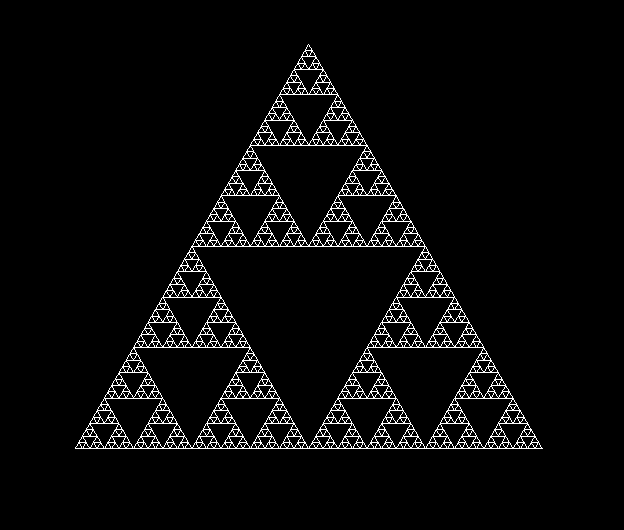
Sierpinski Triangle (Gasket, Sieve)
As a challenge to myself, I wanted to build Sierpinski Triangle in a single point wrangle node in Houdini (link here).
I have built it in python and L-systems in Houdini which both easily utilize the recursive nature of the object.
However, in point wrangle nodes, recursion is not supported. Thus, an iterative approach must be taken.
Waclaw Sierpinski (1882-1969) was a Polish mathematician who is recognized for his work on set theory, point set topology and number theory. More information about his life can be found at https://mathshistory.st-andrews.ac.uk/Biographies/Sierpinski/
Three well-known fractals are named: Sierpinski triangle, Sierpinski carpet, Sierpinski curve.
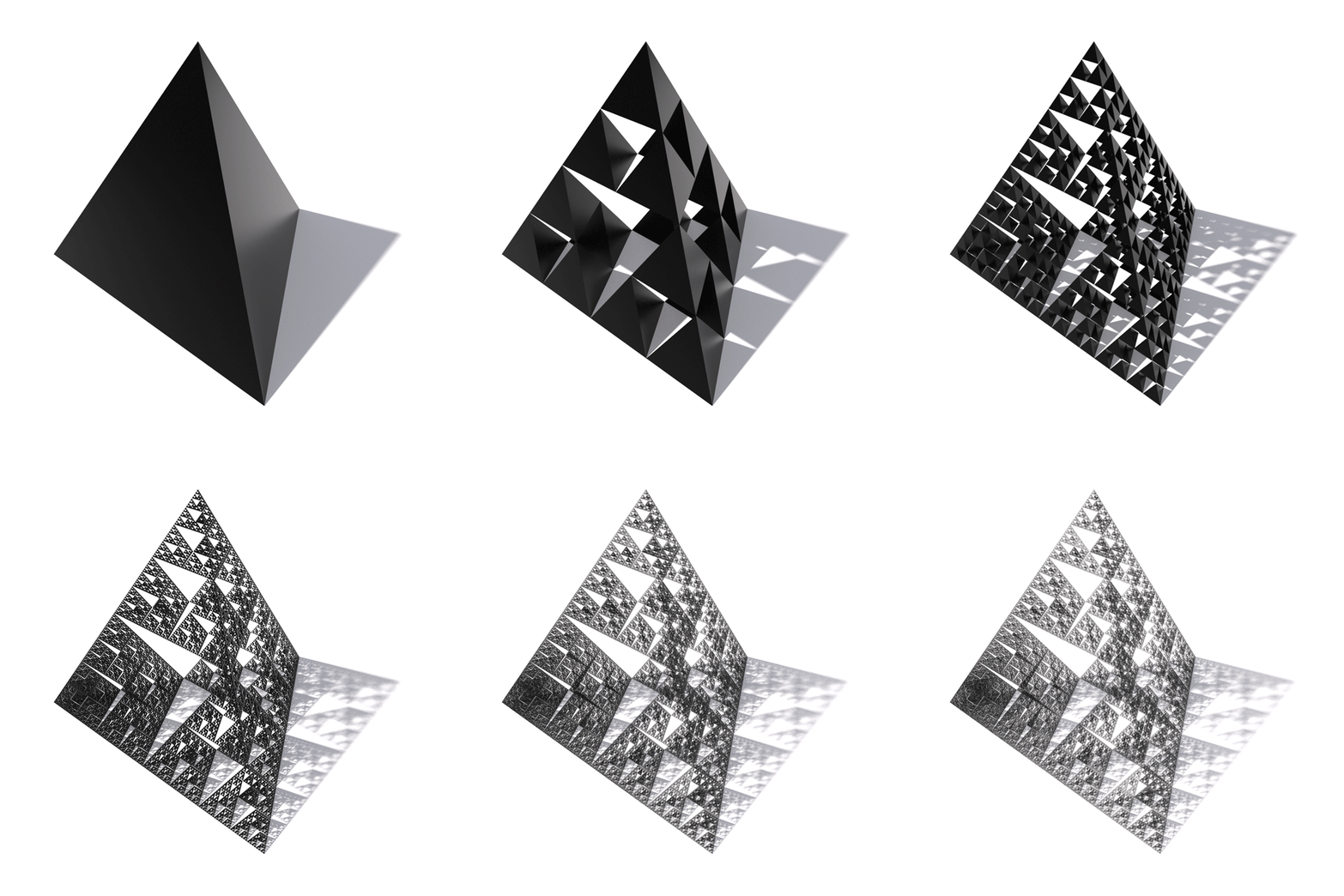
Both 2D and 3D versions can be created.
3D - Start with a tetrahedron (coordinates given for a regular
tetrahedron at
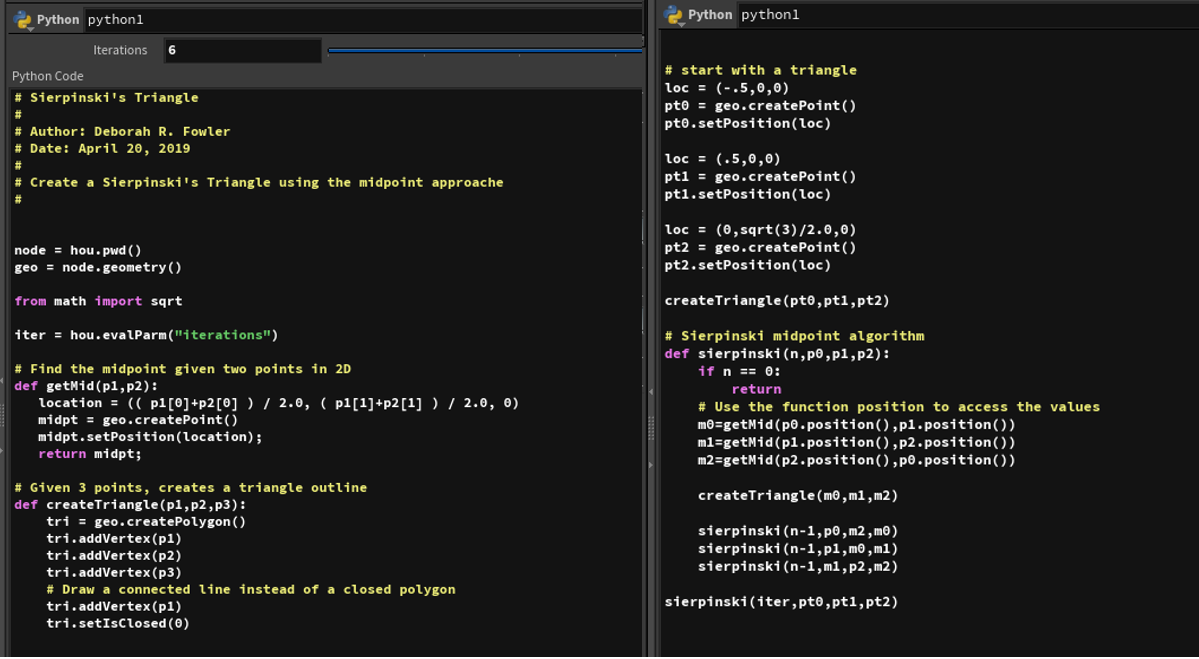
Python version:
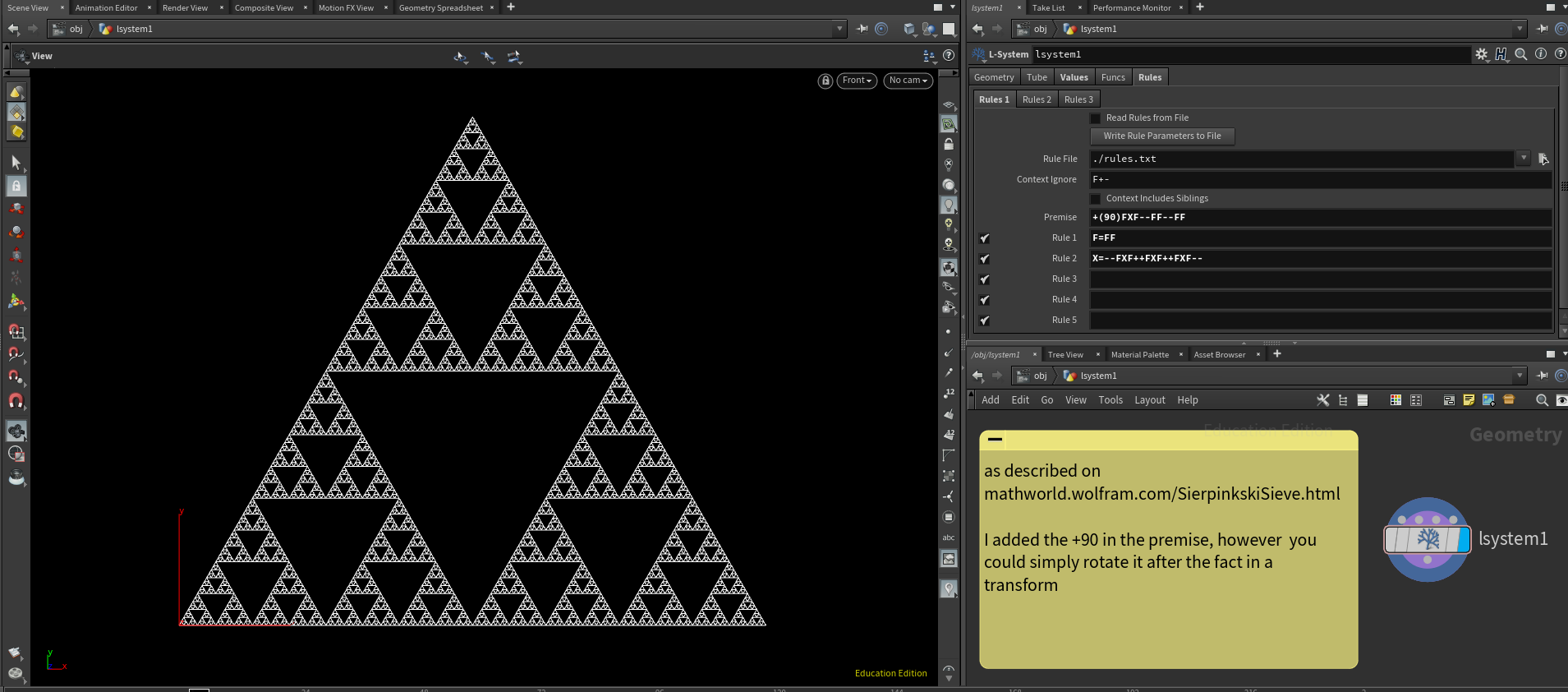
L-system version
As described on http://mathworld.wolfram.com/SierpinskiSieve.html
  Premise: +(90) FXF - - FF - - FF
  Rules:
    F = FF
    X = - - FXF + + FXF + + FXF - -
    Angle is 60
Also described in python with turtle: https://runestone.academy/ns/books/published/pythonds/Recursion/pythondsSierpinskiTriangle.html